A multiplex is one building, or a few small ones, with two to eight homes on a single lot: a duplex, triplex, fourplex or sixplex. Many cities in Canada and the US now allow them on lots that used to hold one house. How many homes you get depends on the zone, the floor area limit and a few conditions, so the count changes city by city.
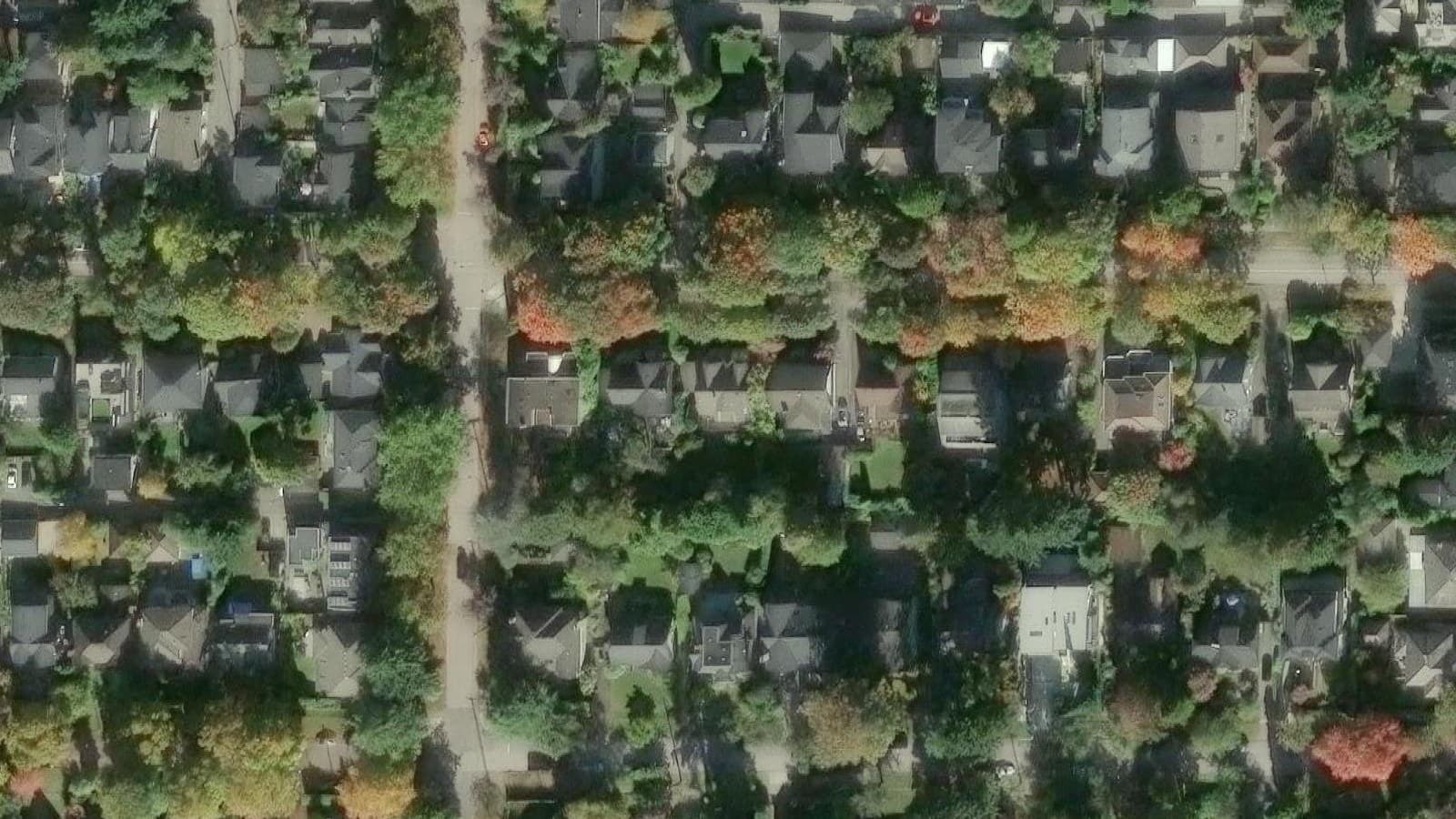 Imagery: Esri World Imagery
Multiple dwelling in R1-1 is a conditional approval use: the Director of Planning approves it if it meets the schedule. The lot also needs rear vehicular access and must sit outside the flood plain (§ 2.2.8).
Each step adds homes, and usually adds a rule or two.
Outright in Vancouver R1-1 and allowed in most Toronto residential zones.
Austin allows up to three homes on SF-1 to SF-3 lots.
As-of-right across Toronto since May 2023.
Toronto and East York wards plus Ward 23. Vancouver R1-1 for strata.
Vancouver R1-1, if all homes are secured rental (§ 2.2.7).
Examples, not a full list. Toronto: City of Toronto multiplex housing page. Austin: City of Austin, HOME Amendments. Vancouver: R1-1 schedule as stored in Bucky.
As-of-right means no rezoning: you apply for a permit and meet the rules.
Sources: City of Toronto, Multiplex Housing; City of Vancouver memo on R1-1 (May 2025) and the R1-1 schedule; Province of BC, Small-scale multi-unit housing; City of Austin, HOME Amendments; California HCD SB 9 fact sheet. Local rules change often, so confirm before you design.
The floor area limit is for the whole building. Every extra home takes a share.
On 3458 W 33rd Av, the base ratio of 0.70 allows about 547 m² of floor area. Split six ways, that is about 91 m² per home before stairs and walls. The rental path raises the ratio to 1.00, or 782 m², which is what makes eight homes workable. Bucky also checks each home against a 35 m² minimum.
Gross floor area divided evenly, before stairs, walls and exclusions. Bar scale 0 to 300 m². The 1.00 ratio is at the Director of Planning’s discretion (§ 3.1.1.1).
The same building type can be outright in one zone, conditional in another and banned in a third.
From live Bucky snapshots. Toronto By-law 569-2013, 10.10.20.40 and 10.10.20.20. Vancouver R1-1 § 2.1. Cedar Park Code § 11.03.061 and § 11.02.092. “Conditional” means allowed if the use meets set conditions or gets approval.
These are the rules that most often change the unit count on a real lot.
In R1-1, a multiplex needs vehicular access from the rear of the site (§ 2.2.8).
R1-1 keeps or plants 1 tree on lots under 15.1 m wide, and 2 on wider lots like this one (§ 2.2.1).
An R1-1 rental eightplex needs at least 3 homes with 2 or more bedrooms (§ 2.2.9).
Some extra homes are only allowed as secured rental, not strata or condo.
Austin has no parking minimums, and BC removed them near frequent transit for Bill 44 homes.
More homes can mean more fire separation, exits and sprinklers. Ask your designer early.
Start with the zone. It sets which building types are allowed and the most homes per lot. Then divide the floor area limit by the number of homes to see if each is a livable size, and check conditions like lane access, tenure and lot size.
The zoning already allows it. You still need a building permit and must meet every rule, but you don’t need a rezoning or a council vote.
It depends on the by-law. Vancouver R1-1 lists “duplex with secondary suite” as its own use, with one suite per home at most (§ 2.2.3). Other cities count every home toward a single unit limit.
Often. Vancouver needs at least 306 m² for a new multiplex, BC’s Bill 44 steps from 3 to 4 homes above 280 m², and Austin keeps 5,750 ft² for two and three homes.
Bucky lists permitted and conditional uses, floor area and lot minimums for an address.